
Why Most City Landing Pages Are Just Digital Ghost Towns
Why Most City Landing Pages Are Just Digital Ghost Towns (And How to Fix Them)
In my 15 years as a Local SEO Strategist, I have seen every shortcut in the book. But the one that pains me most is the “City Landing Page” strategy – or what it has become. You know the ones: dozens of near-identical pages, each targeting a different suburb, with nothing but a swapped-out H1 and a generic map embed. Today, these pages are nothing more than digital ghost towns. They exist on your sitemap, they might even be indexed, but they have zero visitors, zero engagement, and absolutely no ranking power in a modern search environment. At localseosoftwareservice.com, we call this the “Ghost Town effect.” Google is aggressively cleaning up these spammy local SEO practices, treating thin, templated pages as the noise they are. If your strategy relies on these hollow shells, you aren’t just wasting crawl budget; you are signaling to Google that your brand lacks local authority. To survive 2026, you must understand Why Your City Landing Pages Feel Like Ghost Towns (And How to Fix Them) by pivoting toward hyperlocal depth.
The 2024 Diversity Update: Why Your Old Strategy is Failing
The landscape of local search shifted dramatically with the 2024 Diversity Update. For years, SEOs could dominate a region by spinning up 50 city pages for every tiny hamlet in a 30-mile radius. That era is officially over. Google’s algorithms have become remarkably sophisticated at identifying “doorway pages” – content created solely to rank for specific queries rather than provide actual value. When you publish duplicate content across multiple city pages, you aren’t just failing to rank; you are creating a liability for your entire domain.
At localseosoftwareservice.com, we’ve observed that the wrong landing page strategy can actually drain organic traffic from your primary service pages. Google now prioritizes “searcher satisfaction” and “information gain.” If your “Plumbing in Springfield” page is 95% identical to your “Plumbing in Shelbyville” page, Google’s diversity filters will likely suppress one – or both. This update was designed to prevent a single company from monopolizing the SERPs with low-quality, repetitive results. To stay competitive, you need to master the latest local seo ranking factors and google map pack ranking factors. The goal is no longer about the quantity of pages, but the unique local utility each page provides. If you find your rankings flatlining despite adding more content, you’re likely a victim of this shift. You can read more about this in our deep dive: The Brutal Truth About Why Your Local SEO Campaign is Stalling in the Suburbs.
The Synergy Between GBP and City Landing Pages
A city landing page cannot exist in a vacuum. In the current ecosystem, your on-site content must be tethered to your Google Business Profile (GBP) to see any real movement in the Map Pack. This is where most businesses fail; they treat their website and their GBP as two separate entities. In reality, they are two halves of the same whole. To rank google business profile effectively, your landing page must reinforce the three pillars of local search: Relevance, Distance, and Prominence.
Relevance is achieved when your city page content mirrors the services and attributes listed on your GBP. If your profile says you offer “Emergency 24/7 Roofing” but your landing page only talks about general shingles, there is a disconnect. We’ve found that keeping your profile aligned with on-site content is the single most effective way to boost google business profile seo. When you use google business profile seo techniques, you are essentially providing Google with a consistent map of who you are and where you operate. Distance is a fixed factor, but Prominence is where you can win. Prominence is built through local citations, reviews, and – crucially – how well your city page proves you are a fixture in that specific community. Without this synergy, even a verified profile will struggle. This is often Why Your Dental Office Still Fails to Rank Even with a Verified Profile; the website fails to provide the local “proof” the GBP promises.
Moving Beyond “Prime Real Estate”, The Hyperlocal Content Shift
Most SEOs think “Prime Real Estate” means having a page for every zip code. I disagree. Prime real estate in 2026 is the “Hyperlocal” space. Most people just put the city name in the H1, sprinkle it in a few subheaders, and call it a day. This fails because it ignores the intent of hyperlocal SEO and geo targeted seo. Users in specific neighborhoods have specific needs. A homeowner in a historic district has different plumbing concerns (old pipes, heritage restrictions) than a homeowner in a brand-new suburban development.
To fix your digital ghost towns, you must advocate for solving user needs rather than just matching search queries. If a specific suburb has low search volume, your page shouldn’t be thin; it should provide extreme value to that specific local community. This might include mentioning local landmarks, neighborhood-specific case studies, or even local weather impacts on your service. This level of detail proves to Google that you aren’t just a “service provider” in the area – you are an expert on the area. Stop thinking about local seo services as a volume game. It is an authority game. If you continue to churn out the same old templates, you are just adding more ruins to your ghost town. For a better approach, see our guide: Stop Publishing Generic Blogs: A Better Way to Build Local Authority. Using advanced local seo tools can help you identify these hyperlocal nuances that your competitors are missing.
Technical Leaks: Why Your Map Pin Disappears Two Blocks Away
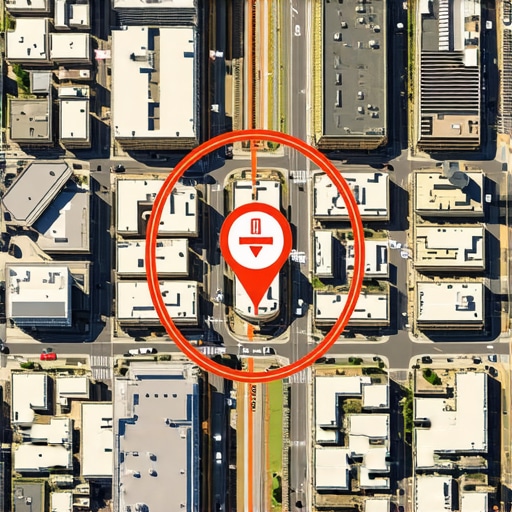
One of the most frustrating experiences for a business owner is seeing their business rank #1 when they are standing in their office, only to watch that pin disappear from the Map Pack two blocks away. These are “Search Dead Zones,” and they are usually caused by proximity traps and “proximity ceilings.” Manual audits almost always miss these issues because they only provide a snapshot of a single location.
The “3-Mile Radius Trap” is a very real phenomenon where a business’s visibility drops off a cliff once a user moves beyond a certain distance, regardless of how good their google maps ranking service or city page seo might be. This happens when your Prominence and Relevance aren’t strong enough to overcome the Distance factor. To diagnose this, you need a google maps rank tracker that uses grid-based tracking. This allows you to see exactly where your “authority” ends. By identifying these leaks, you can tailor your city page content to target those specific “dead” neighborhoods, effectively pushing your proximity boundaries outward. I’ve seen this first-hand: Grid Tracking Revealed Exactly Where My Business Disappears in the Map Pack, and only then could we apply the technical fixes needed to reclaim that territory.
The 2026 Local SEO Playbook: Automation and Real-Time Monitoring
As we move toward 2026, the manual “set it and forget it” approach to local SEO is a recipe for failure. The winners will be those who leverage local seo software and google maps seo tools to stay ahead of the curve. You need to be monitoring your local rankings in real-time, not just for your own progress, but to defend against competitor tactics like map hijacks and fake business closures.
The modern playbook requires a local ranking software that can alert you the moment a competitor moves into your “Prime Real Estate” or when your GBP health dips. Furthermore, performing a regular google business profile audit tool check ensures that your NAP (Name, Address, Phone) data remains consistent across the web. Automation doesn’t mean losing the “human” touch of hyperlocal content; it means freeing up your time to focus on that content while the software handles the grueling task of monitoring thousands of data points. I’ve personally transitioned my workflow to this model, and the results speak for themselves: I Replaced Hours of Manual Audits with One Automated SEO Tool Workflow. In the high-stakes world of google business profile optimization, speed and data are your greatest allies.
Conclusion: Auditing Your Way Out of the Ghost Town
The shift from quantity to quality is not just a suggestion; it is a requirement for anyone who wants to rank higher on google maps. The “Ghost Towns” of yesterday’s SEO – those thin, uninspired city landing pages – are being phased out by an algorithm that values hyperlocal authority and genuine user engagement. To fix your rankings, you must stop building more pages and start building better ones.
Begin by performing a comprehensive google business profile audit to ensure your foundation is solid. Then, look at your city pages through the lens of a local resident. Do they offer real value, or are they just placeholders? Use SEO Viper Tools to track your progress, identify your proximity leaks, and monitor your competition. The road out of the ghost town is paved with data-driven, hyperlocal content and a relentless focus on GBP synergy. It’s time to reclaim your local rankings and turn those ghost towns into thriving hubs of lead generation.